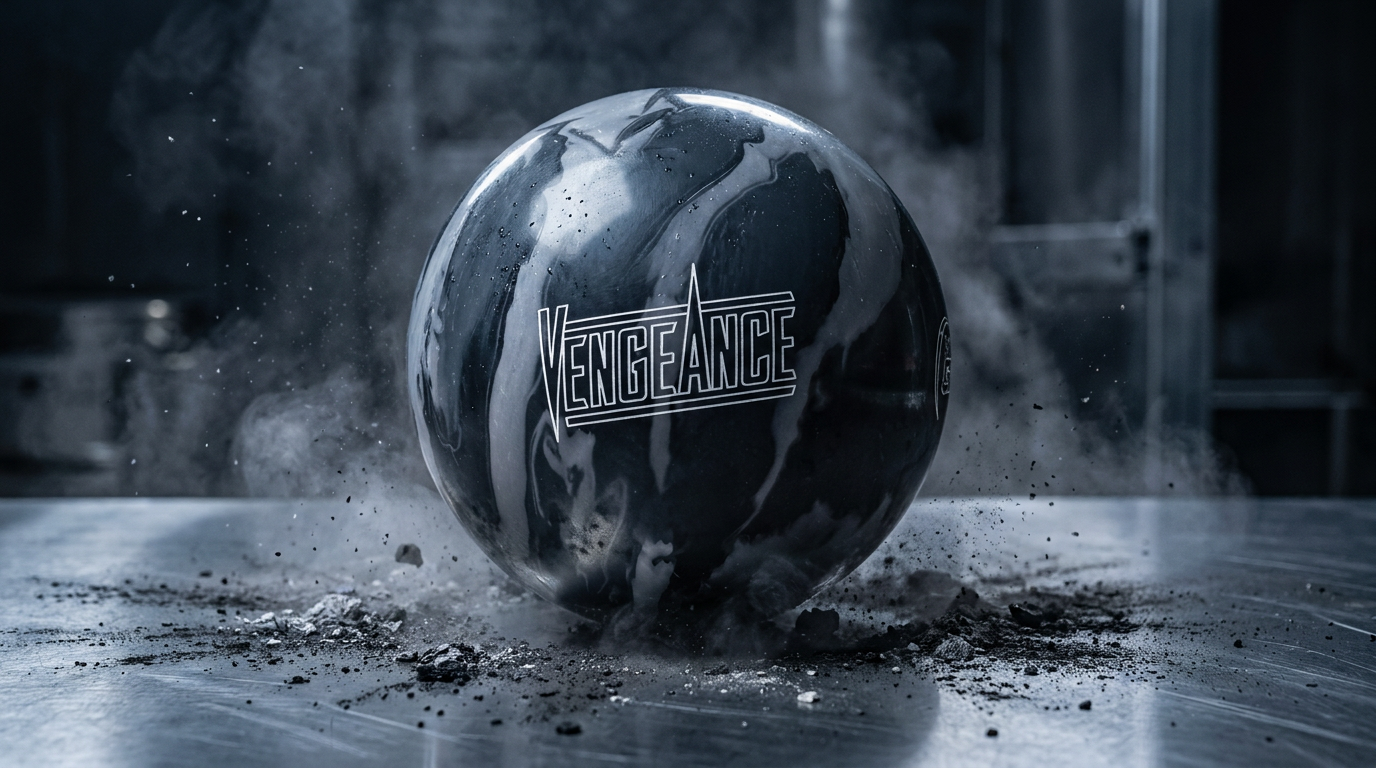
The Vengeance: A Strong Symmetrical That Doesn't Quit When You Move Left
You've got your Rockstar for smooth lanes and your Phase 2 for when oil breaks down. But what about that in-between moment—when you need a symmetrical that reads the boards early, holds energy downlane, and won't abandon you if you play left? That's the gap the Vengeance fills.
Performance
The Vengeance is a strong symmetrical solid (Blast AI core, RB91 coverstock, 2000 grit finish) engineered for medium-heavy to heavy oil, with reviewers consistently praising its energy retention and downlane shape. Multiple reviewers noted it hooks noticeably harder than the Rockstar—one described it as "definitely a much stronger option"—and reads the front and mid-lanes earlier due to its very low RG (2.47) and high differential (0.055). The ball's defining trait is versatility: it allows straighter play or aggressive left-side angles without quitting, delivering what one reviewer called "continuous" shape rather than an early hook that dies. However, reviewers disagreed slightly on its position in 900 Global's lineup—one called it comparable to the Phase 2 in shapability, while another positioned it as a true middle ground between the Rockstar and Phase 2, with one noting it felt "a little less shape" than expected when thrown at similar speeds to the Rockstar.
Pros
- Strong, continuous downlane shape that doesn't quit when moved left—versatile for multiple shot angles
- Noticeably stronger than the Rockstar with earlier midlane read, yet still smooth enough to throw straighter lines
- Reliable strike ball on fresh and heavily oiled conditions; one reviewer bowled a 300 with it on a house shot
- Fast-absorbing coverstock supports consistent reaction as lane transitions
- Works well polished to higher grit for smoother, more controlled motion in challenging conditions
Cons
- Positioning in 900 Global's symmetric lineup creates overlap—not essential if you already own Phase 2 or Rockstar
- Can leave corner pins if speed isn't controlled, particularly when played too far right
- Not recommended for dry or light-oil house shots; engineered specifically for medium-heavy and heavier conditions
Who Should Buy This
- League and tournament bowlers on fresh or heavily oiled house shots seeking a dependable second ball with real downlane shape
- Bowlers who own a Rockstar but need something stronger that still holds energy through the pin deck
- Players who want one symmetrical that works across multiple oil volumes without early quitting or erratic reaction
- Competitors stepping into fresh or high-volume conditions who want a non-nonsense, reliable strike ball
Who Should Skip This
- Bowlers on light or dry house shots—this ball is engineered for medium-heavy oil and up
- If you already have both Phase 2 and Rockstar, you may not need a third benchmark symmetrical in the same bag
- Players who can't control ball speed or prefer to play one line, as the Vengeance rewards being able to move without losing energy
Buying Tips
Factory finish is 2000 grit; consider polishing to higher grit if you want smoother reaction on challenging or fresh patterns. One reviewer found layout matters—a 60×5×30 or similar mid-pin placement balances early read with manageable control. Dull cover out of box means it will read earlier than a polished equivalent, so adjust your starting line accordingly on fresh oil.
Verdict
The Vengeance is a legitimately strong symmetrical that earns its spot in bags where oil volumes run medium-heavy and up. It's not flashy—it's a working ball—but reviewers consistently found it more versatile and energetic than comparable alternatives, making it a smart benchmark choice for bowlers who need energy retention and multi-angle play rather than just early hook.
Specs
| Weight | RG | Differential | Mass Bias |
|---|---|---|---|
| 16 lb | 2.46 | 0.056 | -- |
| 15 lb | 2.47 | 0.055 | -- |
| 14 lb | 2.48 | 0.056 | -- |
| 13 lb | 2.58 | 0.047 | -- |
| 12 lb | 2.64 | 0.037 | -- |
FAQ
How much stronger is the Vengeance compared to the Rockstar?
One reviewer stated it is "definitely a much stronger option" than the Rockstar and noted needing significantly slower ball speed to get the Rockstar to react the same way. The Vengeance's higher differential (0.055 vs. lower on Rockstar) and lower RG contribute to earlier, more aggressive motion.
Where does the Vengeance fit if I already own a Phase 2?
Reviewers offered mixed takes: one felt the Vengeance was "a little earlier just because of how dull it comes out of box," while another positioned it as "a little more on the phase 2 side as far as shapability." If you have Phase 2, the Vengeance may be redundant unless you want the specific benefit of the RB91 cover or prefer the color scheme.
Will this ball quit on me if I move it left?
No—that's its calling card. One reviewer specifically praised how "when I moved left, it didn't really want to quit on me that much. Still retained enough energy to kind of get those swisher hits." This makes it more forgiving on left-side angles than smoother symmetricals.
What oil conditions is this ball designed for?
Medium-heavy to heavy oil, per the manufacturer description. One reviewer noted that with a 0.055 differential, "0.50 plus is high, so this means it's going to be one of them balls that's more on a fresh" condition or high-volume house pack. Not recommended for dry or light-oil shots.
How does the 2000 grit factory finish affect how I should throw it?
The dull finish means the ball reads the lane earlier out of the box. One reviewer noted it comes "a little earlier just because of how dull it comes out," so expect more midlane read than a polished version. You can polish it higher for smoother, more controlled reactions if needed.
Is the Vengeance a good starting ball for tournament play?
Yes, according to one reviewer who called it strong enough to start league and tournament, with the caveat that you control ball speed well. Another suggested it as a benchmark ball for competitive bowlers on fresh or high-volume conditions, though skill matters—corner pins can be left if speed management is poor.