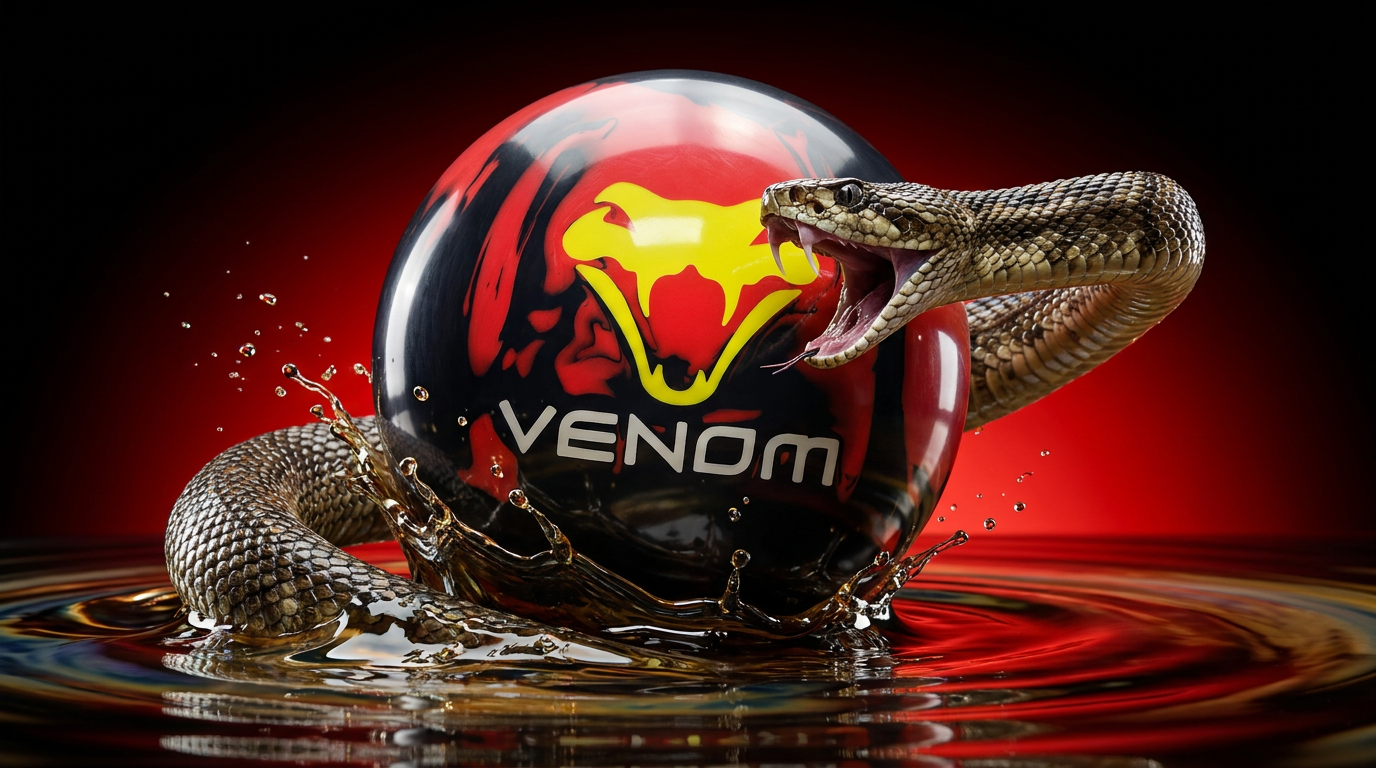
MOTIV Lethal Venom: The Smooth, Predictable Asymmetric That Doesn't Apologize for Control
You're standing on fresh oil with a mild asymmetric in your hand, and you're nervous. Will it hook too early and die? Will it fight you down the lane? The Lethal Venom settles that argument immediately—it gets up early, moves predictably, and lets you play the shot you planned.
Performance
The Lethal Venom pairs the Leverage MXC Solid Reactive coverstock (3000 Grit LSS) with the Gear APG asymmetrical core to deliver a smooth, heavy-rolling arc that reads the lane consistently without aggression or surprise. Reviewers consistently describe it as early and controllable—it begins motion sooner than symmetric Venoms but maintains a continuous, arcing shape rather than turning sideways on the backend. The strong coverstock is the primary driver of hook; multiple reviewers note this creates a ball that rolls more smoothly than competitors' offerings (like Storm's Ion Pro) while still punching through the pins with solid finishing power. Some find it slightly less hooky than expected for an asymmetric solid, and its motion works best on medium to medium-heavy oil patterns—it can feel overpowering on lighter house shots and lacks the cleanliness needed for extremely dry lanes.
Pros
- Early, smooth, predictable motion—does what you expect, every time
- Leverage MXC Solid coverstock delivers strong traction while the Duramax technology extends time between surface maintenance
- Excellent driving power through the pins with a controlled, authoritative finishing move
- Versatile across medium to fresh oil patterns and multiple rev rates; low-rev bowlers can still generate continuous motion
- Stands out from competitor asymmetrics (Ion Pro, Effect Tour) with noticeably rounder, less angular hook shape
Cons
- Not ideal for bone-dry lanes—lacks the cleanliness some bowlers need when friction spikes
- The strong coverstock can feel overpowering on lighter house shots; it's niche in that respect
- Less aggressive backend torque than heavier asymmetrics like the Jackal Ghost; some high-rev bowlers may find it softer than they want
- On fresh, super-wet backends it can lose some of its arcing shape and become less responsive
Who Should Buy This
- Tournament bowlers who need a predictable, mid-control benchmark ball they can trust across multiple oil volumes
- Bowlers frustrated with surface maintenance—the Duramax technology in the Leverage MXC helps it hold its finish longer than previous Venom models
- Players who prefer smooth, continuous motion over aggressive backend pop and want earlier traction without early combustion
- Bowlers looking for a first asymmetric or a reliable step up from weaker solids without overcomplicating their arsenal
Who Should Skip This
- Bowlers on extremely short, light-oil house shots where a strong cover can overwhelm the lane
- Players who prioritize sharp angular backend reaction or heavy torque—this ball prioritizes control and smoothness
- Those wanting a cleaner front-lane skid; the Leverage MXC reads friction earlier than some competitors
Buying Tips
Keep the factory 3000 Grit LSS finish for most conditions; reviewers maintained it at either 2000 or 4000 grit depending on lane friction needs. Drill it with a moderately high pin position (above fingers) to maximize early read without sacrificing smoothness; pairing it with the Black Venom (sharper, cleaner coverstock, same core) in your arsenal gives you a strong control-vs.-response gap. This is a medium-oil benchmark ball—bring it to tournaments for fresh patterns, not for broken-down conditions.
Verdict
The Lethal Venom is a genuinely smooth, benchmark-caliber solid that delivers on its promise of predictable, controlled motion without fussy adjustments. It's best suited for tournament bowlers and serious league players who value consistency and smooth lane reading over flashy hook or arena-style pop, and it stands up well against competitors in its category. If you bowl fresh oil regularly and want a ball that reads early but doesn't betray you on the backend, this belongs in your bag.
Specs
| Weight | RG | Differential | Mass Bias |
|---|---|---|---|
| 16 lb | 2.48 | 0.032 | 0.011 |
| 15 lb | 2.47 | 0.036 | 0.013 |
| 14 lb | 2.5 | 0.033 | 0.012 |
| 13 lb | 2.56 | 0.028 | 0.009 |
| 12 lb | 2.63 | 0.02 | 0.007 |
FAQ
How does the Lethal Venom compare to the Venom Shock?
The Lethal Venom is stronger and smoother than the Venom Shock. Both use the Gear APG core, but the Lethal Venom's Leverage MXC Solid coverstock creates a heavier-rolling arc with more traction earlier in the lane. One reviewer used the Lethal Venom 17 of 18 games in back-to-back PBA regionals because of its superior predictability and mid-lane roll combined with strong finishing power—traits the Shock doesn't provide to the same degree.
Should I pick the Lethal Venom or the Black Venom?
They share the same Gear APG core but have completely different coverstocks and ball motions. The Lethal Venom is early, rolly, smooth, and very predictable with early traction. The Black Venom is cleaner through the front and more responsive, better suited for broken-down lanes. Choose the Lethal Venom if you want an early, rolling ball on medium to fresh oil; pick the Black Venom if you need something cleaner and sharper for transition and dry conditions.
How does it hook compared to the Storm Ion Pro?
The Lethal Venom hooks earlier than the Ion Pro and has a slightly cleaner path through the fronts. Reviewers note the Lethal Venom produces a more arcy reaction overall, while the Ion Pro requires more boards to set up. On fresh oil, the Lethal Venom is more controllable; on heavier patterns, both work, but the Lethal Venom's motion is rounder and more predictable.
Is this ball good for league or just tournaments?
It excels in both, but shines in tournament play and fresh-pattern league environments. The 3000 Grit LSS finish and Leverage MXC coverstock are medium-to-heavy oil focused. On a typical shorter house shot, the strong cover can overwhelm the lane. It's a versatile mid-control benchmark piece, but it works best when there's enough oil to let it read early without over-reacting.
Will I need to resurface this ball frequently?
Less often than older Venom models. The Duramax technology in the Leverage MXC coverstock helps it maintain its 3000 Grit LSS finish longer between maintenance sessions. One reviewer specifically praised this as a reason to choose it for tournament blocks where consistency between games matters.
How does it perform for lower-rev bowlers?
Surprisingly well. The heavy-rolling, arcy motion means lower-rev bowlers can generate continuous, predictable motion down the lane. Reviewers noted that dropping speed or using a smoother release still produces a reliable arc. Higher-rev bowlers need fresh, tougher conditions to see its full potential; lower-rev bowlers benefit from it on standard house shots and slightly longer patterns.