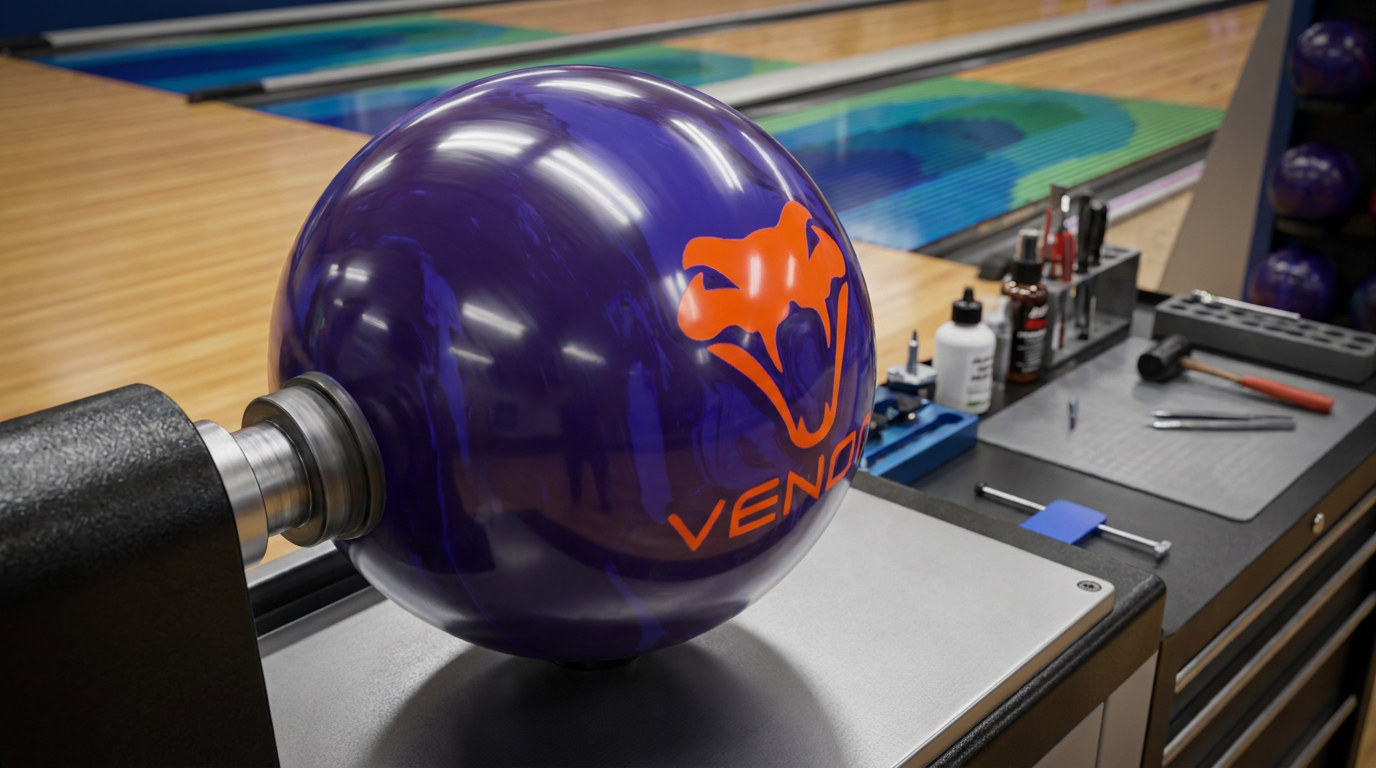
MOTIV Venom Shock: The Benchmark That Still Reads the Lane Better Than Anything Else
You're stepping up to the lanes for league night, and you have no idea what the oil pattern looks like today—fresh backends, carrydown in the middle, or something in between. You need a ball that won't lie to you, one that tells you exactly what the lane is doing so you can adjust everything else in your bag accordingly. That's the Venom Shock.
Performance
The Venom Shock produces an early hook reaction off the hand with a smooth, controlled motion that clears the front of the lane cleanly. Most reviewers agree it excels as a first-ball-out-of-the-bag on light to medium oil, reading lane conditions reliably without overreacting. The ball does break earlier than some competitor benchmarks (like the IQ Tour) and generates a continuous hook shape—though one reviewer noted the coverstock reaches stable performance quickly but requires regular surface maintenance (changing 1,000 to 3,000 grit in about 10 shots) to maintain that predictability. On fresh or high-oil conditions, stronger reactive pieces will outmuscle it; on shallow angles and house shots, it delivers consistent, dependable carry.
Pros
- Clear lane reader—tells you what conditions you're facing better than almost any other ball
- Smooth, early-hook motion with predictable motion on house shots and shallow angles
- Proven durability over 12+ years; resurfaced versions perform nearly identically to new ones
- Works effectively throughout entire bowling blocks as a stepping stone to stronger pieces
Cons
- Coverstock surface changes rapidly and requires frequent maintenance to stay consistent
- Weaker recovery than modern reactive pieces—can 'peter out' when asked to cover deep oil or extreme angles
- Less angular backend than some newer competitors with updated coverstock technology
- Can be overly aggressive if thrown too directly; performs best with committed, shaped releases
Who Should Buy This
- League bowlers who need a reliable first read on varying house patterns
- Tournament players who value predictable control and lane feedback over raw hook
- Anyone willing to maintain the coverstock surface regularly for consistent performance
- Bowlers using shallow to medium angles who don't want an aggressive backend reaction
Who Should Skip This
- Bowlers on fresh, high-volume oil who need a stronger recovery ball
- Players looking for an all-oil-condition workhorse without surface upkeep
- Two-handed bowlers or those with very direct release angles (one reviewer found it overly aggressive when thrown that way)
Buying Tips
Plan to resurface this ball regularly—reviewers demonstrated it needs surface maintenance every 10 shots or so to maintain stable performance, but proper care keeps it viable for years. Drilling layout matters: one reviewer used a pin-down layout for late-block control. Check your local pro shop for current pricing and ask about their resurfacing options upfront.
Verdict
The Venom Shock remains the gold standard benchmark ball after more than a decade in production because it does one thing better than anything else: it shows you exactly what the lane is doing. If you value lane feedback and predictability over raw power, and you're committed to maintaining your equipment, this is the first piece you need in your bag.
Specs
| Weight | RG | Differential | Mass Bias |
|---|---|---|---|
| 16 lb | 2.48 | 0.031 | -- |
| 15 lb | 2.48 | 0.034 | -- |
| 14 lb | 2.52 | 0.029 | -- |
| 13 lb | 2.58 | 0.023 | -- |
| 12 lb | 2.65 | 0.016 | -- |
FAQ
How does the Venom Shock compare to the Brunswick Alert?
When both balls are set to the same surface grit (4700), they perform nearly identically. The Alert has newer coverstock technology, while the Venom Shock is older—but at stable surface, neither has a decisive edge. One reviewer noted the Venom Shock tends to be slightly smoother and more controlled, while the Alert shows a bit more aggressive backend when conditions demand it.
Is the Venom Shock still relevant compared to newer MOTIV balls?
Yes. Reviewers consistently call it the 'GOAT' of MOTIV's lineup not because it's the strongest, but because nothing has surpassed its longevity and proven performance over 12+ years. Stronger balls like the Venom Hysteria exist for heavy oil, but the Shock remains unmatched as a benchmark and lane-reading tool.
Will resurfacing an older Venom Shock bring it back to like-new performance?
Essentially yes. One reviewer compared a resurfaced Venom Shock with 4-6 years and tons of games on it directly to a brand new one, and found they performed very similarly on the lanes. The resurfaced version was smooth and reliable, with only slightly less downlane motion due to coverstock pore saturation—typical behavior for any bowling ball.
Does this ball work for tournament bowling?
Yes, especially for bowlers who value control and predictability. One expert noted it's recommended for tournament bowlers needing predictable control on unknown lane conditions, though you'll need to maintain its surface regularly. It works best on house shots and shallower angles rather than as a deep-oil power piece.
How does the Venom Shock hook compared to other benchmarks like the IQ Tour?
The Venom Shock breaks earlier off the hand than the IQ Tour while still clearing the front of the lane cleanly. Both allow straighter-line play, but the Shock's hook comes sooner and is more angular, making it less suitable for very high-friction or volume conditions where you need to play deep.
Why does the coverstock change surface so quickly?
The Turmoil MFS coverstock is a fast-absorbing reactive resin. It transitions from 1,000 to 3,000 grit in about 10 shots, meaning it reaches stable performance very quickly but then requires regular resurfacing to maintain that predictable state—this is a trade-off for the reliable early-game reaction reviewers praise.