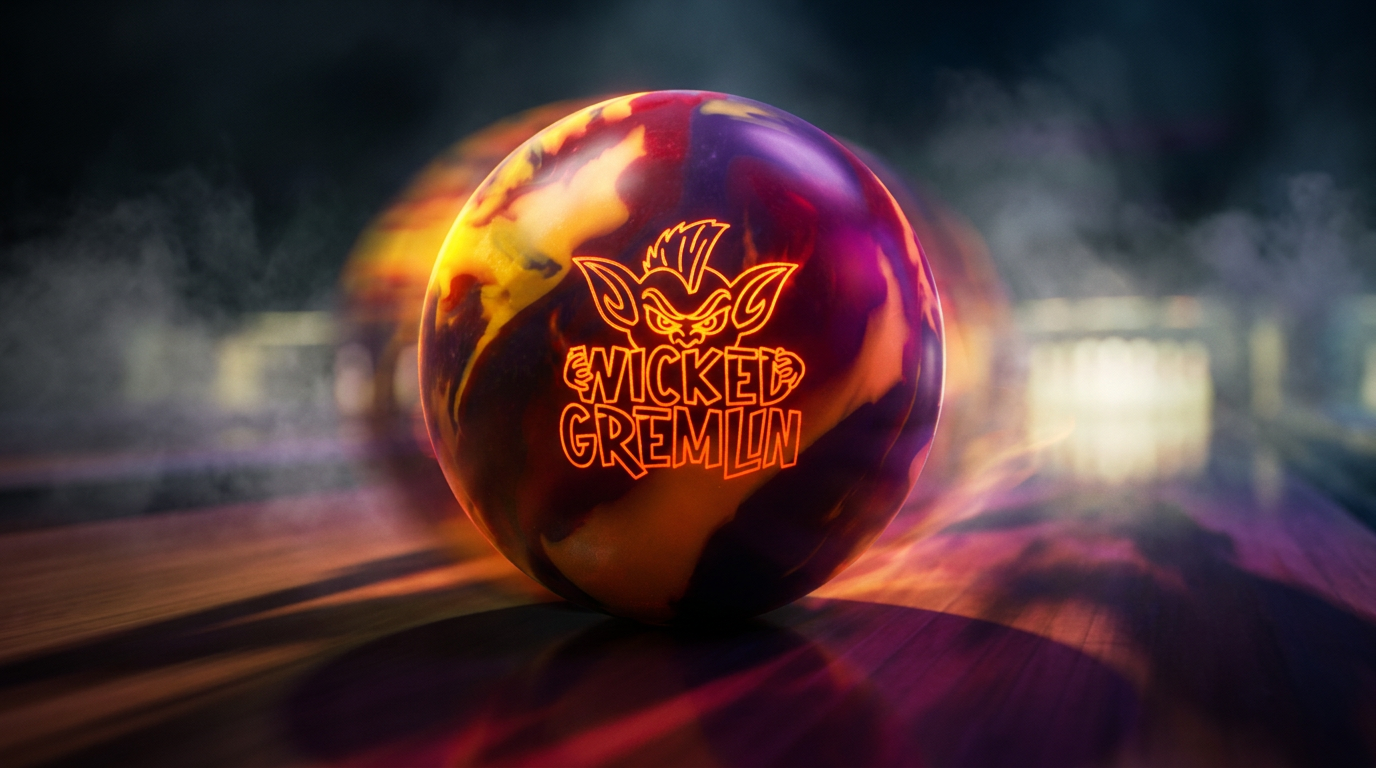
Roto Grip Wicked Gremlin: The Smoother Middle Ground Between Control and Aggression
You've got the original Gremlin dialed in, but lately the lanes are asking for something with more teeth—something that reads earlier without going full nuclear on you. The Wicked Gremlin trades the skid-flip character of its predecessor for a rounder, more continuous hook that still knows when to stop.
Performance
The Wicked Gremlin pairs the Rondure MaxD core from the original Gremlin with a new GR1 Solid coverstock at 2000 grit—stronger than what came before but still nano-free and measurably smoother than Ion Max or RST Hyperdrive formulas. Reviewers consistently report early, aggressive hook that burns up the midlane faster than expected, requiring finesse with release speed and angle to avoid missing the breakpoint; one reviewer compared it favorably to the Origin EX in overall character. The ball produces significant flare and good traction without maximum aggression, landing in a niche between quicker symmetrical pieces and premium-strength asym balls—useful when you need control and friction without getting locked into the front.
Pros
- Strong, smooth, continuous hook shape without being as extreme as top-tier asyms
- Significant flare and good midlane read with solid friction
- Early enough to see the lane quickly, but still has float through the front
- Versatile piece that fills genuine gap between symmetrical balls and nuclear-strength asym options
Cons
- Burns up and stabilizes surprisingly quickly, especially with strong drilling layouts, requiring careful speed control
- Not as strong as nano-additive formulas; you're paying for smoothness, not maximum traction
- Early hook means you'll need to play straighter angles on fresh shots; misses left can be costly
- Requires finesse to dial in—not a plug-and-play ball
Who Should Buy This
- Higher rev players on fresh or medium-volume house shots who need early read without extreme backend snap
- Bowlers stepping up from the original Gremlin who want more angular hook and continuation
- Two-handers seeking a smoother, more controllable strong solid that won't over-flip
- Players on heavier oil patterns who need a ball that reads the lanes without burning up immediately
Who Should Skip This
- Bowlers who prefer long skid-flip motion (the original Gremlin's defining character is gone here)
- Those needing maximum traction or nano-additive strength—this cover is intentionally weaker
- Speed-dominant bowlers on short oil who may find it hooks too early and too hard
Buying Tips
Expect to play straighter angles than you might with other strong solids; start further right than you think you need to. Strong drilling layouts (4+ inches from pin) are recommended to prevent too-quick transitions. The factory 2000-grit finish is aggressive enough to keep as-is on fresh house shots, but sanding adds midlane read while polishing extends length if you need it.
Verdict
The Wicked Gremlin succeeds at what it sets out to do: give you the Gremlin core with a roomier, more hookable reaction. It's best suited for higher rev players or those on volume patterns who want controlled aggression and smooth midlane motion without settling for weak covers or fighting maximum-strength flip.
Specs
| Weight | RG | Differential | Mass Bias |
|---|---|---|---|
| 16 lb | 2.5 | 0.056 | -- |
| 15 lb | 2.5 | 0.058 | -- |
| 14 lb | 2.54 | 0.058 | -- |
| 13 lb | 2.57 | 0.032 | -- |
| 12 lb | 2.59 | 0.029 | -- |
FAQ
How does the Wicked Gremlin compare to the original Gremlin?
The Wicked Gremlin uses the same Rondure MaxD core but wraps it in a much stronger, more aggressive coverstock. Reviewers noted it delivers significantly more hook and a more continuous, angular reaction versus the original's skid-flip character, traveling shorter distances before its aggressive breakpoint.
Is this ball stronger or weaker than the Alpha or other nano-additive covers?
The GR1 Solid is intentionally weaker than nano-additive formulas like the Alpha. Reviewers compared it more to the Origin EX or Equinox Solid in strength—strong enough to provide good traction and early read, but positioned as a step down from maximum-aggression covers.
Why does it slow down and stabilize so quickly, especially with strong layouts?
Multiple reviewers noted the ball tends to burn up and hook earlier than expected, particularly when drilled with strong (high-flare) layouts. This appears to be the combination of the high-differential core with the mid-range coverstock strength—it reads friction quickly and doesn't have enough float to delay the reaction.
What rev speed works best with this ball?
Reviewers recommend it especially for higher rev players or those with stronger revolutions. Low rev players may find it hooks too aggressively and too early. Fresh house shots and medium-volume patterns suit it best.
How does it compare to the Gremlin Tour X?
The Gremlin Tour X uses a weaker Tour-edition core and hybrid coverstock, making it smoother, slower, and more forward-going. The Wicked Gremlin is noticeably stronger, earlier, and more aggressive—filling a different niche despite the shared Gremlin name.
Should I leave the 2000-grit finish as-is or modify it?
Reviewers tested it at factory 2000 grit on fresh house shots and found it effective. You can sand to add more midlane read or polish to extend length, but the factory finish is aggressive enough that most bowlers won't need immediate surface changes on typical patterns.